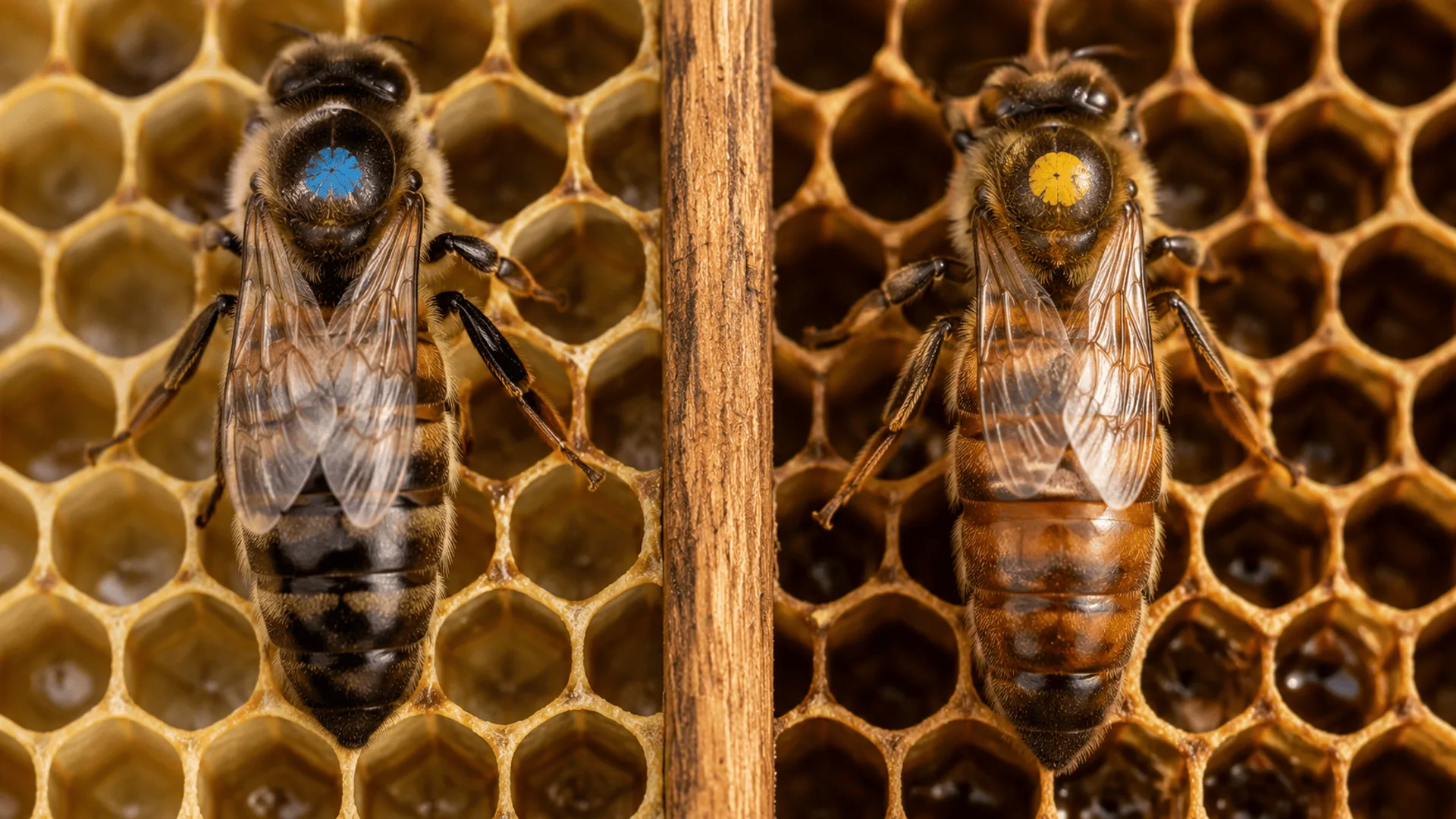
Carnica vs Buckfast: Which Queen Bee Suits Your Apiary?
Carnica vs Buckfast bees compared: temperament, honey yield, wintering, swarming and varroa. Which breed fits your climate, nectar flows and experience?
Quick answer: Carnica is a natural subspecies known for a very gentle temperament, fast spring buildup and frugal wintering. It suits continental climates, early nectar flows and beekeeping close to people. Buckfast is a selected breed built from several subspecies, with steady productivity through summer and a lower swarming tendency. Both are excellent; pick by your climate and nectar-flow timing rather than by reputation. Neither breed is varroa-resistant: both need monitoring and treatment.
If you keep bees in Europe, two names dominate the breeding catalogues: Carnica (the Carniolan honey bee) and Buckfast. Both are loved by professional and hobby beekeepers, yet they differ noticeably in temperament, productivity and management style.
Neither is better in general. Which one suits you depends on your climate, the timing of your nectar flows and how much swarm management you are prepared to do.
Where Carnica and Buckfast come from
Carnica (Apis mellifera carnica) is a natural subspecies named after Carniola, today part of Slovenia. Its native range covers the Eastern Alps and the northern Balkans, from Slovenia and southern Austria to Croatia and Serbia. (Romania’s native bee is a different subspecies, the Carpathian bee, A. m. carpatica.) Carnica evolved in a continental climate with cold winters and a short, intense spring. Beekeepers have been selecting Carnica lines since the late 19th century.
Buckfast was developed by Brother Adam (Karl Kehrle), a German-born beekeeper at Buckfast Abbey in south-west England, who began the work in 1916 after acarine disease (the tracheal mite) had wiped out most colonies in Britain. The starting point was a cross of the surviving native British bees with Italian bees; over the following decades he added Anatolian, Greek, French and other strains. The result is a breed selected for traits rather than for descent from one subspecies, and it is still bred as a closed population today.
That difference, a natural subspecies versus a selected combination breed, explains much of how they behave.
Temperament: which bee is gentler?
Carnica is famously gentle. Many colonies can be inspected with little smoke and without gloves. They stay calm on the comb, tolerate handling well and rarely follow the beekeeper. This makes them a common choice for urban beekeeping, hobby apiaries and teaching apiaries where stings near children or neighbours would be a problem.
Buckfast is also gentle, because Brother Adam selected hard for docility, but some lines are slightly more “alert”. They notice intrusion sooner and may follow the beekeeper a little farther from the hive. Still very manageable, but Carnica is the safer pick if the hives stand close to people.
In both breeds, temperament depends more on the line and on mating control than on the name. Crosses between the two, especially in later generations, can be noticeably more defensive than either parent.
Verdict: Carnica wins on raw gentleness; Buckfast is close behind.
Honey production
Both are excellent producers, but their style differs:
Carnica builds up fast in spring. It reacts strongly to the first pollen and nectar, so the colony reaches foraging strength early, often before Buckfast in cooler climates. It also reduces brood rearing sooner when the flow ends in late summer. Net effect: very good spring and early-summer yield, more modest late-summer yield.
Buckfast has a steadier, flatter productivity curve. It builds up more evenly in spring and keeps a large brood nest and foraging force through summer. In warm climates or regions with long late flows (heather, sunflower, late summer forage), Buckfast often outperforms Carnica because it is still at full strength when Carnica colonies have already scaled down.
Verdict: Carnica for spring-dominated flows (oilseed rape, black locust/acacia, lime/linden in Central Europe); Buckfast for long flows and milder climates.
Wintering
This is where Carnica’s origin shows. It:
- Overwinters as a compact cluster and shrinks its brood nest early in autumn
- Consumes less winter food, because the winter colony is smaller
- Builds up quickly once the first pollen comes in
Buckfast winters well in most of Europe, but it usually goes into winter as a larger colony and needs more stores. In harsh continental winters (Romania, Poland, eastern Germany), Carnica’s frugality gives it an edge in food consumption and spring development.
Verdict: Carnica for harsh continental winters; Buckfast is fine wherever winters are moderate, as long as stores are generous.
Varroa and disease: is either breed resistant?
Both breeds have selected lines with good hygienic behaviour: workers detect and remove diseased or mite-infested brood. How hygienic a colony is depends on the specific breeder line, not on the breed name.
Neither Carnica nor Buckfast is varroa-resistant as a breed. Brother Adam’s famous resistance work was against acarine disease (the tracheal mite), long before varroa arrived in Europe. Today, breeders of both Carnica and Buckfast run selection programmes for varroa tolerance, and some lines show measurable progress, but no commercial queen of either breed removes the need to monitor mite levels and treat when thresholds are reached.
Verdict: judge the breeder’s selection work, not the breed name, and plan varroa control for every colony.
Side-by-side comparison
| Trait | Carnica | Buckfast |
|---|---|---|
| Origin | Natural subspecies (Eastern Alps, northern Balkans) | Selected combination breed (Buckfast Abbey, from 1916) |
| Temperament | Very gentle | Gentle |
| Spring buildup | Fast, reacts early to forage | Steady |
| Late-season activity | Scales down early | Sustained |
| Winter colony | Small, frugal | Larger, needs more stores |
| Best climate | Continental, mountain, harsh winters | Mild to warm, long nectar flows |
| Honey style | Spring/early-summer dominant | Consistent through summer |
| Swarming tendency | Higher (needs swarm management) | Lower |
| Varroa | Line-dependent, needs treatment | Line-dependent, needs treatment |
| Uniformity | Depends on mating control | Depends on mating control; later crosses segregate |
Which should you pick?
Choose Carnica if:
- Your climate is continental or mountainous (Romania, Austria, Poland, southern Germany, alpine regions)
- Spring and early summer bring your main flows (oilseed rape, black locust, lime)
- Gentleness is paramount (urban beekeeping, near schools, near houses)
- Winters are harsh and you want frugal overwintering
- You’re a hobby beekeeper learning the basics: Carnica forgives mistakes
Choose Buckfast if:
- Your climate is mild or you have long late-season flows
- You want steady production through summer rather than a spring peak
- You’re comfortable with slightly more “alert” bees in exchange for sustained foraging
- You want a lower swarming tendency and large, strong colonies
- You manage commercial-scale apiaries where big colonies pay off
Can you keep both in one apiary?
Yes, and many beekeepers do: Carnica for the spring crops, Buckfast for late flows. If you buy mated queens every season, mixing is no problem, because each queen has already mated. It only matters if you raise your own queens: their daughters will mate with drones of both breeds, and those mixed crosses can become more defensive in later generations. In that case, buy naturally mated queens from breeders who control mating (see semi-isolation vs reproductive isolation).
Common myths debunked
“Carnica is too swarmy.” Older Carnica lines were prone to swarming; modern selected lines are much improved. Timely space and swarm control matter more than the breed.
“Buckfast isn’t a ‘real’ bee.” It’s a combination breed, but the selection has been going on for over a century. It’s stable, proven and used at commercial scale across Europe and beyond.
“Italian queens are better than both.” Italian (ligustica) bees are productive but tend to keep brood rearing going late and use a lot of stores in continental winters. They were one of the parent stocks of Buckfast; Buckfast kept the productivity and gained better wintering through selection.
Closing thought
Choose by your environment and your management style, not by what a friend swears by. If you’re starting out, ask local beekeepers which bee copes with your region’s winters and flows.
At Bienen Königin we breed both:
- Carnica and Buckfast queens from our semi-isolation mating station at 800–900 m altitude
- Selected Buckfast queens from our reproductive isolation station (>90%) at about 1400 m
All are naturally mated and marked. See queens and prices for the season →, check what a queen bee costs, or contact us via WhatsApp for advice on which fits your apiary.
Frequently Asked Questions
Are Carnica or Buckfast bees more gentle?
Carnica is famously gentle and many colonies can be handled with little smoke and no gloves. Buckfast is also gentle but some lines are slightly more "alert". For urban beekeeping or hives close to people, Carnica is the safer choice.
Which bee produces more honey?
Both are excellent producers with different styles. Carnica builds up fast in spring and scales down early in late summer; Buckfast stays strong through summer. Choose based on when your main nectar flows come.
Which breed is better for cold winters?
Carnica evolved in a continental climate: it overwinters as a small, compact colony, uses less winter food and builds up quickly in spring. Buckfast winters well in most of Europe but goes into winter stronger and needs more stores.
Are Buckfast bees varroa-resistant?
No. Neither Buckfast nor Carnica is varroa-resistant as a breed. Brother Adam's resistance work targeted the tracheal mite (acarine disease), long before varroa reached Europe. Breeders of both breeds now select for varroa tolerance and some lines show progress, but every colony still needs mite monitoring and treatment.
Can I keep both Carnica and Buckfast in the same apiary?
Yes, many beekeepers run both: Carnica for spring crops, Buckfast for late flows. If you buy mated queens each season, mixing is no problem. If you raise your own queens, their daughters will mate with drones of both breeds, and such crosses can become more defensive in later generations.
Is Buckfast a "real" breed of honey bee?
Buckfast is a combination breed developed by Brother Adam at Buckfast Abbey from 1916 and selected for over a century. It is not a natural subspecies, but it is a stable, proven breed kept as a closed breeding population and used by beekeepers across Europe.
Related articles
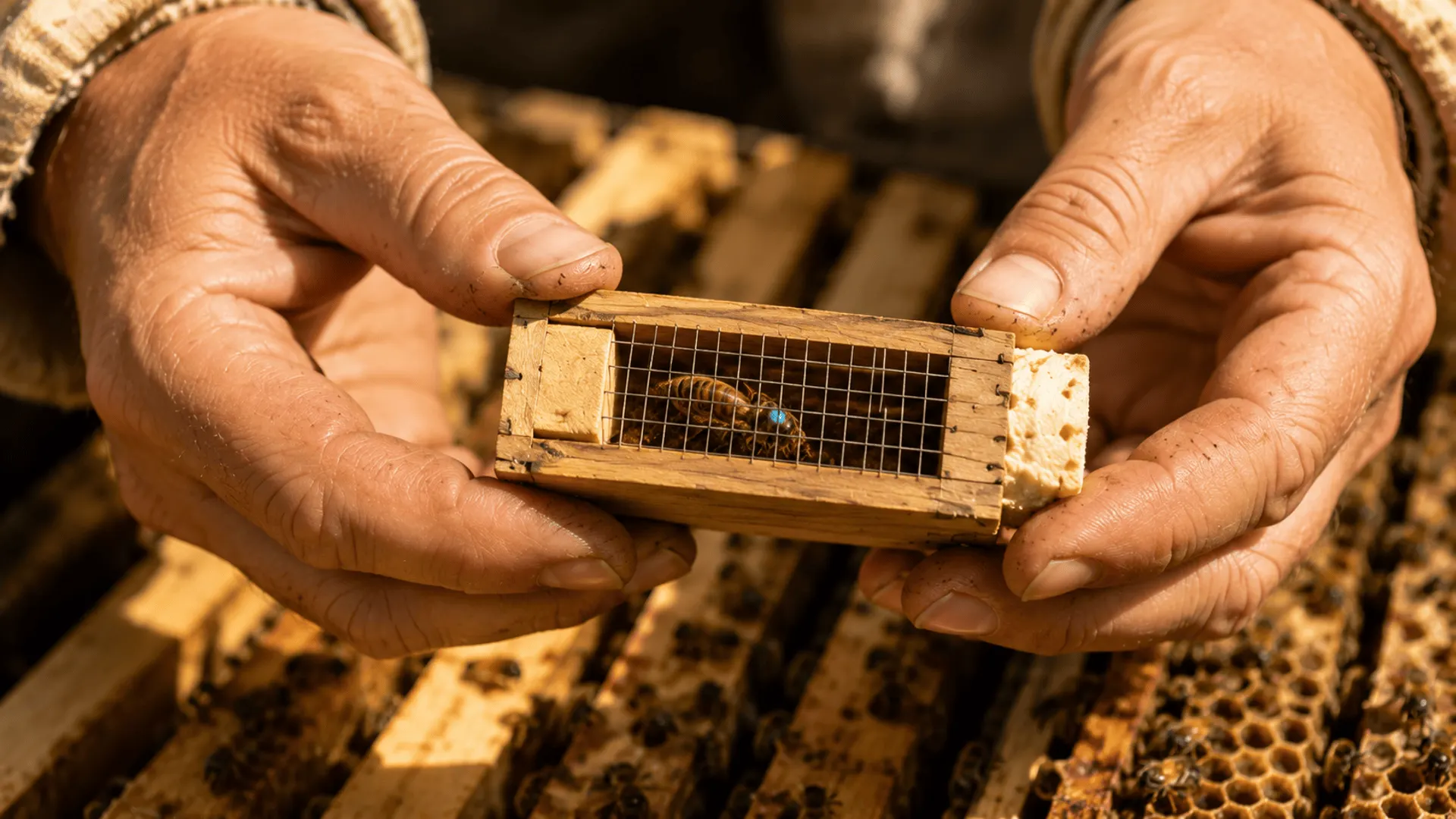
How to Introduce a Queen Bee: Step-by-Step Cage Method
How to introduce a new queen bee with the cage method: prepare the colony, place the cage, when to check, how to confirm acceptance and what to do if she fails.
Laying Workers: How to Spot Them and Save the Colony
Laying workers or a drone-laying queen? How to tell them apart, why laying worker bees reject a new queen, and four methods that work to save the colony.
Queen Bee: What She Does, Lifespan, Size and Mating
The queen bee explained: what she does, how a queen is made, mating flights, how long she lives, how big she is next to workers and drones, and how to spot her.