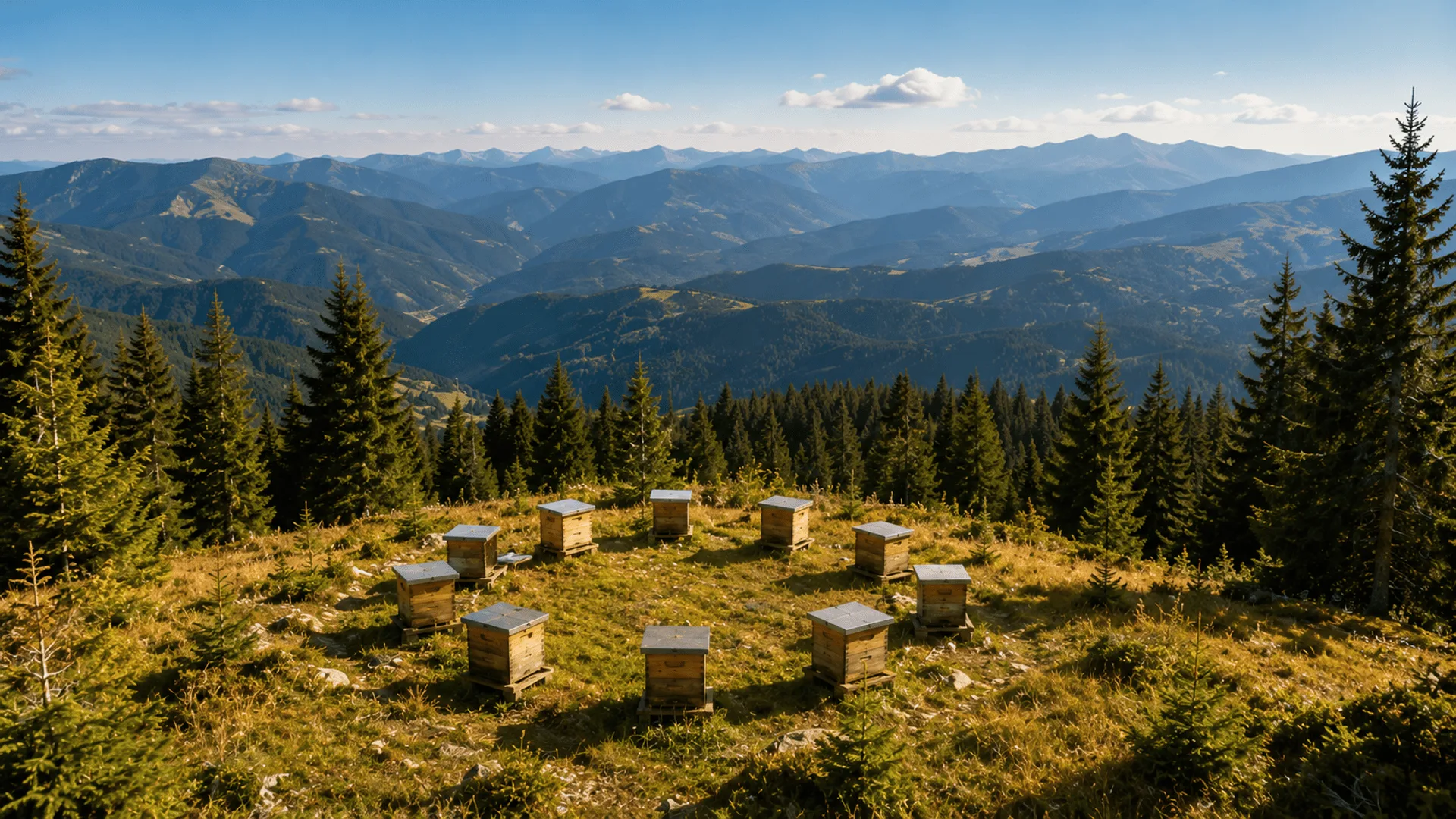
Semi-Isolation vs Reproductive Isolation in Queen Mating
Semi-isolation vs reproductive isolation mating stations: how they control drones, what purity means for your colonies, and what to ask a breeder before buying.
Quick answer: at a semi-isolation mating station, most of the drones in the area come from the breeder’s selected colonies, but some foreign drones remain. At a reproductive isolation station, terrain and distance keep other apiaries out of mating range, so well over 90% of matings are with selected drones. Both produce naturally mated queens. The difference is how reliably the resulting workers express the selected traits, and the price.
When you buy a “naturally mated queen”, what does that actually mean? It means she flew out of her mating nucleus and mated in the air with drones from the surrounding area, usually within a few kilometres, sometimes much farther. Whose drones depends entirely on where the breeder mates the queens: the mating strategy.
This article explains the two strategies used by most serious breeders of naturally mated queens, semi-isolation and reproductive isolation, what each means in practice, and how the difference helps you decide what to buy.
Why the mating strategy matters
A virgin queen mates with 10–20 drones during her mating flights and stores their sperm for life. The workers she produces carry:
- Half of their genes from the queen (and so from her mother’s selected line)
- Half from one of the drones she mated with
If those drones come from uniform, selected colonies, the workers are predictable in temperament, productivity and behaviour. If many drones come from random local colonies, including unselected or defensive stock, some of the workers will inherit very different traits.
The mating strategy controls which drones the young queen meets in flight.
Strategy 1: Semi-isolation
Definition: the breeder mates queens at a site where most, but not all, of the drones in the area come from selected drone colonies. Terrain (valleys, forest, altitude) and distance from other apiaries limit how many foreign drones reach the site.
In practice:
- The mating station lies in a moderately remote location, for example at 800–900 m altitude in mountain regions or in valleys with little beekeeping nearby
- The breeder places strong drone colonies of the selected line around the station, so selected drones far outnumber those from other apiaries
- Most matings are with selected drones; a smaller share comes from neighbouring beekeepers or wild colonies
What it means for you: most workers show the expected traits of the line, with occasional variation between colonies.
Cost: moderate. A semi-isolation station needs scouting and careful drone colony management, but not the logistics of a remote high-altitude site. It’s a common choice for queens intended for honey production.
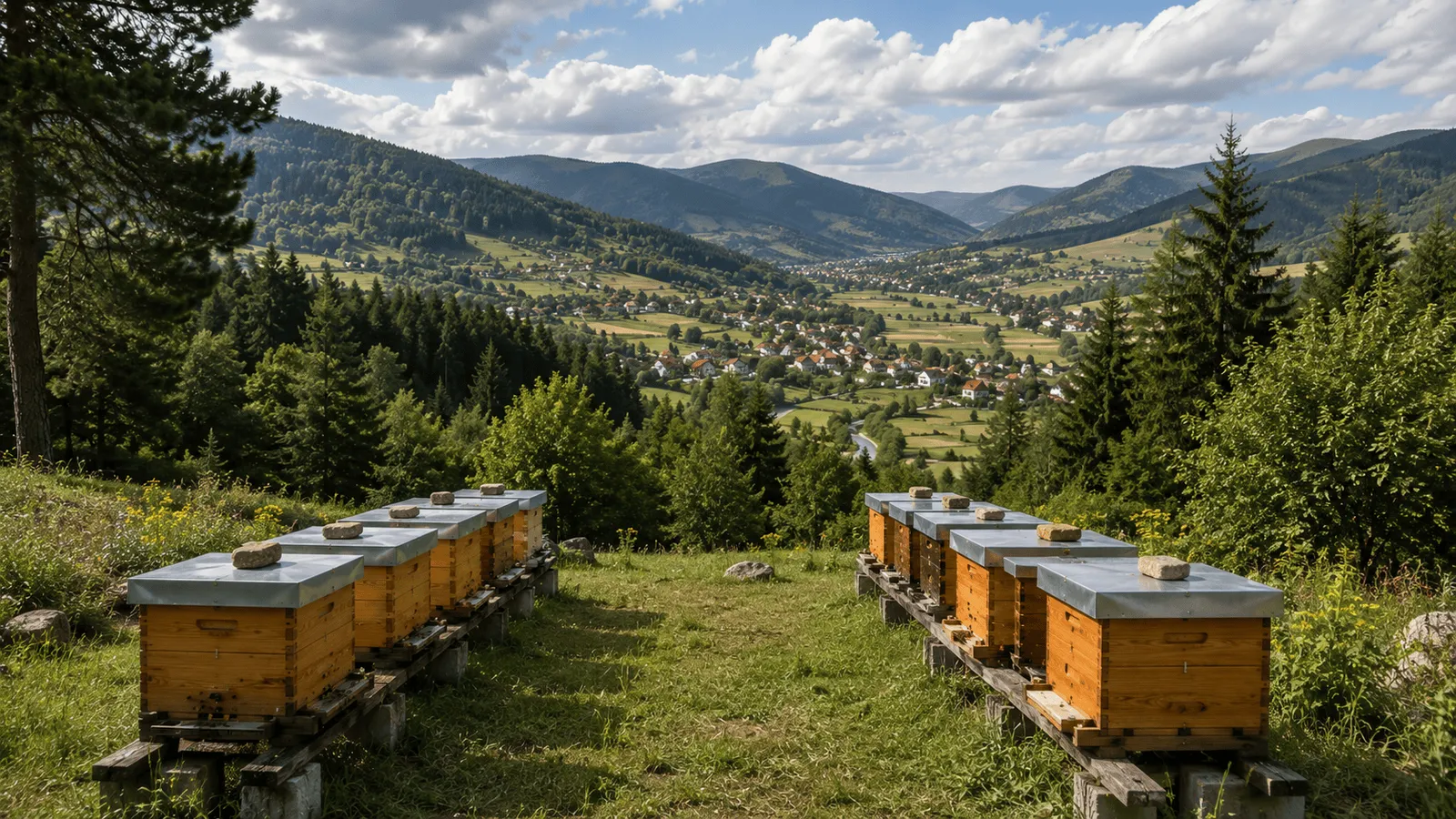
Strategy 2: Reproductive isolation (>90%)
Definition: a mating station in genuinely isolated terrain, for example at 1400 m altitude or higher, in mountain valleys, on islands or in areas with no other beekeepers within mating range. Because drones and queens can fly 5–7 km and sometimes more, a real isolation station needs a wide buffer or strong natural barriers.
In practice:
- Located in remote mountain or island terrain (alpine pastures, isolated valleys, protected mating stations)
- Essentially only the breeder’s selected drone colonies are within mating range
- Achieves more than 90% of matings with selected drones
- Production is limited by the site: few mating days, harsh weather and a short season
- Used mainly for lines where uniformity matters most, such as selected Buckfast
Cost: higher. Colonies and mating nuclei must be carried up the mountain, the weather is less predictable and there are fewer good mating days. The queen is more expensive as a result.
What this means for your apiary
Queens from reproductive isolation give you:
- More predictable temperament from colony to colony
- More consistent performance, because the workers share similar genetics
- A clearer expression of the selected line, for example its gentleness
- Better material for your own queen rearing: if you graft daughters from this queen, you start from a more uniform base
Semi-isolation queens give you the expected traits most of the time, with occasional outliers. For most honey-producing apiaries, that’s perfectly acceptable. For your own queen rearing, or where uniform colonies matter, isolation is worth the higher price.
Side-by-side comparison
| Aspect | Semi-isolation | Reproductive isolation |
|---|---|---|
| Typical altitude | 800–900 m | 1400 m+ |
| Matings with selected drones | Majority | >90% |
| Production volume | Higher | Limited |
| Price | Moderate | Higher (often about double) |
| Best for | Honey production | Own queen rearing, uniform apiaries |
| Trait predictability | Good | Excellent |
For current price levels by type, see how much a queen bee costs.
What to ask before you buy
Good breeders are open about their mating strategy. When you contact one, ask:
-
“Where and at what altitude is your mating station?” Altitude alone is not isolation, but a low-lying site in farmland with apiaries all around is close to open mating.
-
“How many other apiaries are within 5–7 km?” An honest answer reveals the real level of isolation. “Many” or “I don’t know” is a red flag.
-
“How many drone colonies do you keep at the station, and from which line?” A serious station has a sizeable group of strong drone colonies from one selected line.
-
“Are the queens marked?” Marked queens carry a dot in the year’s colour and are easier to find and track. See our queen marking colour chart.
-
“What happens if a queen arrives dead or in poor condition?” Reputable breeders replace queens that arrive dead or in poor condition. Ask for the exact conditions before ordering.
-
“What does your selection work involve?” A breeder with a real programme can describe the parent lines, the traits they select for and how long they have been doing it. Vague answers suggest queen rearing without selection.
Instrumental insemination: a different route
You may also see “II queens” (instrumentally inseminated) advertised. These queens are inseminated by hand with semen from chosen drones, which gives full control over the father side. The trade-off: they skip the natural mating flight, cost more and are mainly used in breeding programmes.
Naturally mated queens (from semi-isolation or reproductive isolation) mate in the open air with many drones and are bought mainly to head production colonies. II queens put genetic precision first and are bought mainly as breeder queens.
Our approach
At Bienen Königin, in Maramureș, Romania, we use two mating stations:
- Semi-isolation station at 800–900 m, producing Carnica and Buckfast queens mated mostly with drones from our selected colonies. Solid quality at an accessible price.
- Reproductive isolation station at about 1400 m (>90%), producing selected Buckfast queens. Limited quantity each season; pre-ordering is recommended.
All our queens are naturally mated and marked. If a queen arrives dead or in poor condition, we replace it free of charge when you send a photo via WhatsApp within 48 hours.
See queens and prices for the season → or contact us via WhatsApp to discuss which line fits your apiary.
Once your queens arrive, follow our guide on how to introduce a queen safely. For the choice of breed, see Carnica vs Buckfast.
Frequently Asked Questions
What is reproductive isolation in queen breeding?
Reproductive isolation means the mating station lies in genuinely remote terrain (for example at 1400 m or higher, in isolated valleys or on islands) with no other apiaries within mating range. Essentially only the breeder's selected drone colonies are within reach, so more than 90% of matings are with selected drones.
How pure is a semi-isolation queen?
At a semi-isolation station most matings are with drones from the breeder's selected colonies, while a smaller share comes from neighbouring apiaries or wild colonies. The expected traits show in most workers, with occasional variation between colonies.
Why are reproductive isolation queens more expensive?
An isolation station needs more work: colonies and mating nuclei are carried up the mountain, the weather is less predictable and there are fewer good mating days, so fewer queens can be produced. That higher cost is reflected in the price.
Should I always buy isolation queens?
Not necessarily. For honey production, semi-isolation queens are perfectly adequate and more affordable. Isolation queens pay off most if you rear your own queens from them or need very uniform colonies.
What's the difference from instrumental insemination (II)?
II queens are inseminated by hand with semen from chosen drones, which fixes the father side completely, but they skip the natural mating flight and cost more. Naturally mated queens (from semi-isolation or isolation) mate in flight with many drones and are bought mainly to head production colonies; II queens are bought mainly as breeder queens.
How can I verify a breeder actually has reproductive isolation?
Ask where the station is and at what altitude, how many other apiaries lie within 5–7 km (the answer should be none), how many drone colonies of which line stand at the station, and what the selection work involves. Vague answers are a red flag.
Related articles
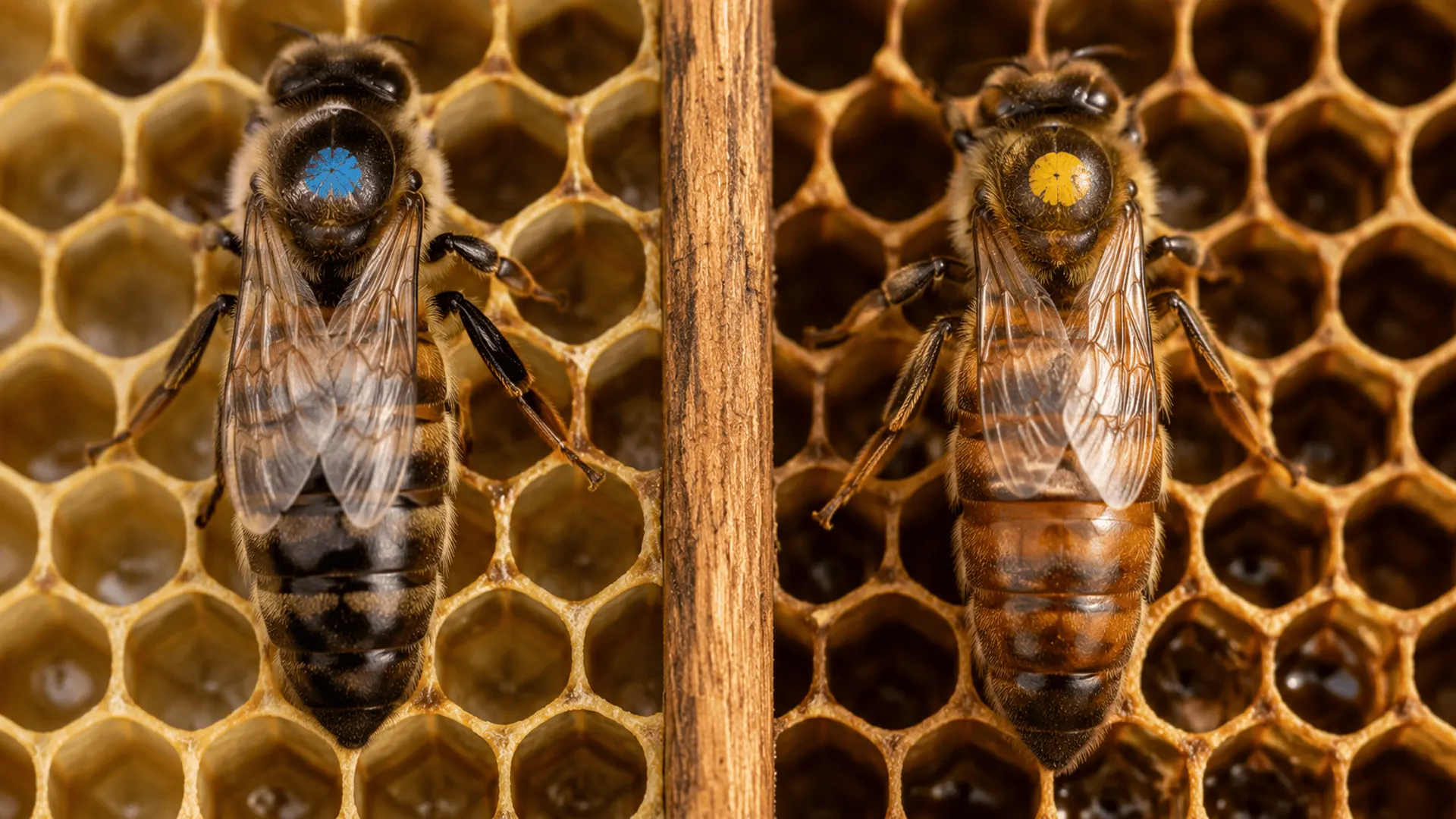
Carnica vs Buckfast: Which Queen Bee Suits Your Apiary?
Carnica vs Buckfast bees compared: temperament, honey yield, wintering, swarming and varroa. Which breed fits your climate, nectar flows and experience?
How to Introduce a Queen Bee: Step-by-Step Cage Method
How to introduce a new queen bee with the cage method: prepare the colony, place the cage, when to check, how to confirm acceptance and what to do if she fails.
Laying Workers: How to Spot Them and Save the Colony
Laying workers or a drone-laying queen? How to tell them apart, why laying worker bees reject a new queen, and four methods that work to save the colony.