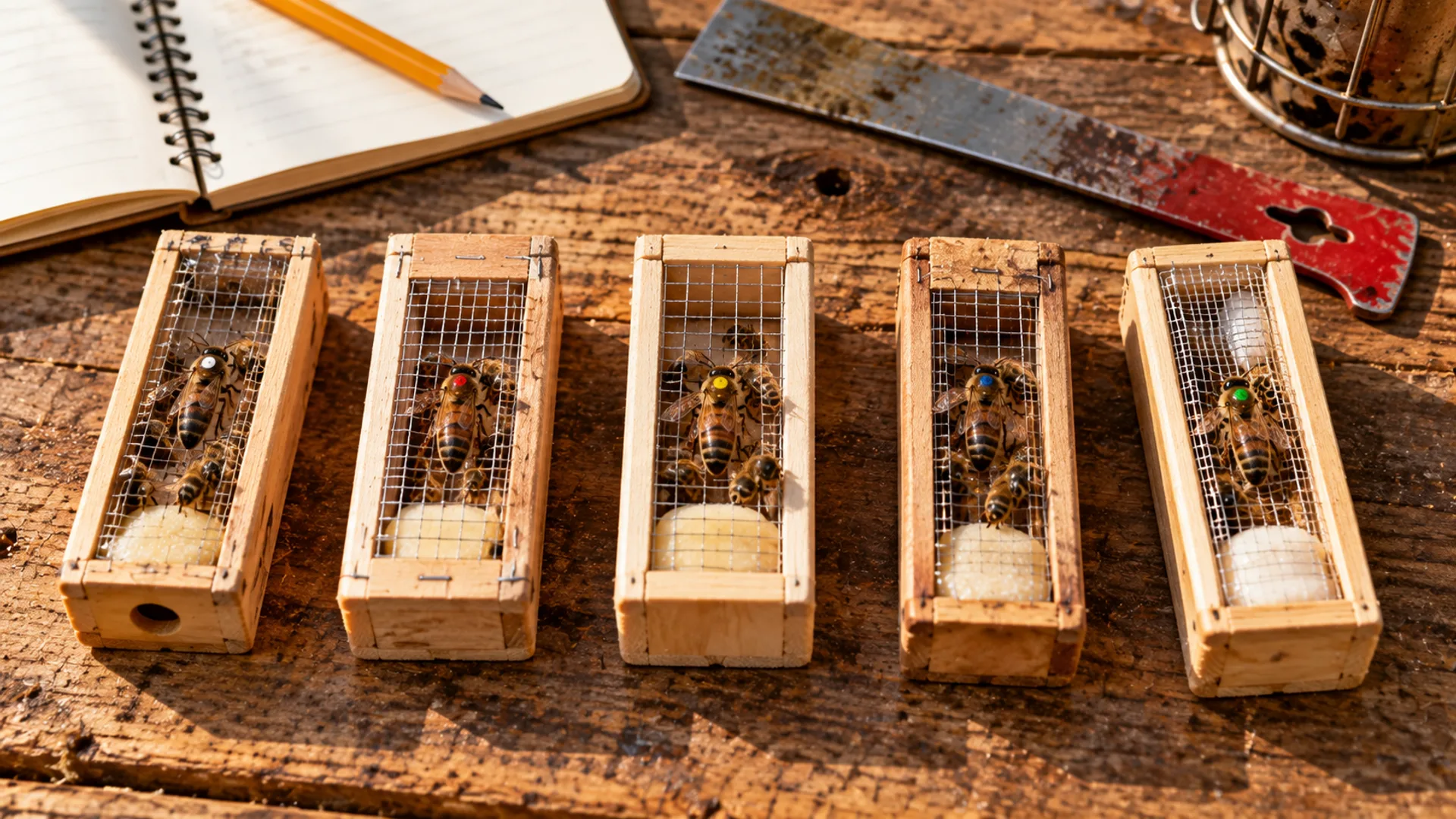
Queen Bee Marking Colour 2027 & 2026: Chart by Year
Queen bee marking colour (color) 2027 is yellow, 2026 is white. Full year chart 2020–2031, a mnemonic and a safe step-by-step method to mark your queen.
Quick answer: The queen marking colour for 2026 is white and for 2027 is yellow. The international code follows the last digit of the year: 1 or 6 white, 2 or 7 yellow, 3 or 8 red, 4 or 9 green, 5 or 0 blue. Put a small dot of paint or an Opalith number plate on the centre of the queen’s thorax, never on the abdomen or wings, and let it dry before you release her.
A marked queen is found in seconds instead of minutes, and her dot tells you how old she is without opening a notebook. The colour system is the same in almost every beekeeping country, so a queen bought from another apiary or another country can be read at a glance. This guide gives you the chart, the reasoning behind it and a calm, safe way to mark a queen yourself.
Queen marking colour for 2026 and 2027
- 2026: white. Every queen raised in 2026 gets a white mark.
- 2027: yellow. Queens raised next season get a yellow mark.
The colour stands for the year the queen was raised, not the year you bought or introduced her. A queen raised in 2026 wears white for her whole life, whenever and wherever she ends up heading a colony.
The international colour code
The code repeats every five years and depends only on the last digit of the year.
| Last digit of the year | Colour |
|---|---|
| 1 or 6 | White |
| 2 or 7 | Yellow |
| 3 or 8 | Red |
| 4 or 9 | Green |
| 5 or 0 | Blue |
Five colours are enough because very few queens stay productive for more than five years. There is no risk of confusing a two-year-old queen with a seven-year-old one.
A mnemonic that works
English-speaking beekeepers use “Will You Raise Good Bees”: White, Yellow, Red, Green, Blue, starting with white for years ending in 1 or 6. If you remember that 2026 is white, you can count forward from there.
Queen marking colour chart, 2020–2031
| Year | Colour | Queen age in the 2027 season |
|---|---|---|
| 2020 | Blue | 7 years |
| 2021 | White | 6 years |
| 2022 | Yellow | 5 years |
| 2023 | Red | 4 years |
| 2024 | Green | 3 years |
| 2025 | Blue | 2 years |
| 2026 | White | 1 year |
| 2027 | Yellow | current year |
| 2028 | Red | |
| 2029 | Green | |
| 2030 | Blue | |
| 2031 | White |
A blue queen in 2027 could in theory be from 2025 or 2020. In practice a 2020 queen still heading a colony in 2027 is so rare that nobody confuses them, and your hive records settle any doubt.
Why mark queens at all
Age tracking. Many beekeepers replace queens after two seasons, because laying and colony strength tend to decline with age. The colour tells you the age the moment you see her.
Finding the queen faster. A queen moving across a frame covered in bees is easy to miss. A bright dot on her thorax catches the eye. That matters whenever you need her: before introducing a new queen, when making splits, or when you are requeening in late summer.
Detecting supersedure. If the colony replaces its queen quietly, you will one day find an unmarked queen where the marked one used to be. Without a mark, you would never know the queen had changed.
Swarm management. In swarming season, a missing marked queen plus open or sealed queen cells tells you clearly that the colony has swarmed, or is about to. You can then act on the cells instead of guessing.
Paint pen or Opalith number plate?
| Paint pen | Opalith number plate | |
|---|---|---|
| What it is | Water-based marker in the year colour | Small coloured disc, numbered, glued to the thorax |
| Individual ID | No, colour only | Yes, number plus colour |
| Speed | Very quick | Slower, needs glue and practice |
| Durability | Can wear off over the seasons | Lasts well, but can occasionally come off |
| Best for | Hobby and production apiaries | Breeders and anyone keeping detailed records |
For most beekeepers a paint pen is enough. Number plates make sense when you need to tell apart queens of the same year, for example in breeding or evaluation work.
How to mark a queen safely, step by step
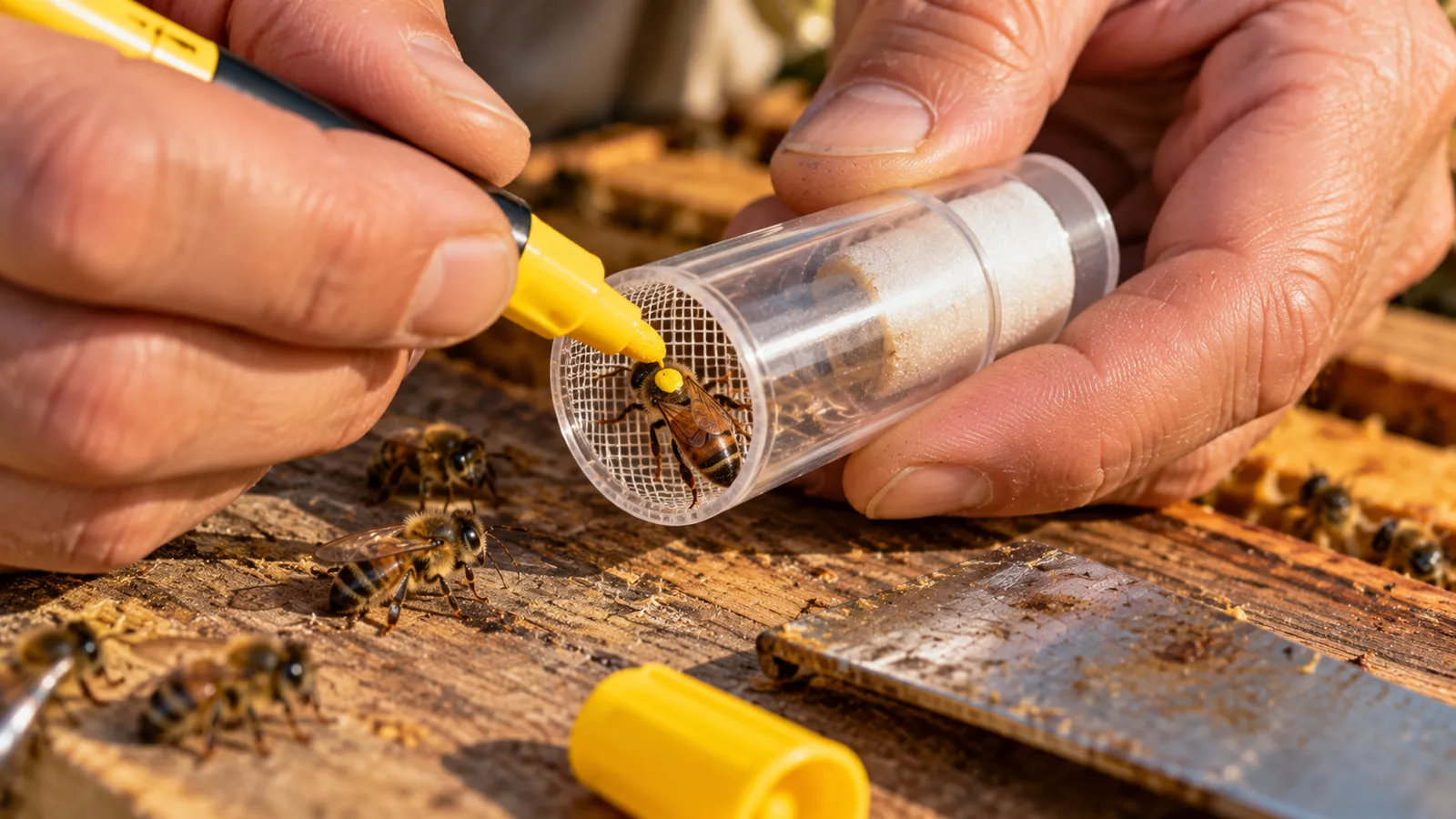
Mark on a warm, calm day, ideally around midday when the foragers are out and the colony is quieter. Practise on drones first: they have no sting, so you can learn the grip and the dot size without risk.
1. Prepare your tools
Shake and prime the paint pen on a piece of wood or paper so it gives a small, even dot. Keep the marking tube or push-in cage at hand. Avoid hand cream and strong scents on your fingers.
2. Find and hold the queen
Lift the frame gently and look for her near eggs and young larvae. Either place a push-in marking cage over her on the comb, or pick her up by the wings or thorax and let her walk into a marking tube with a soft plunger. Never squeeze or hold her by the abdomen.
3. Immobilise her without pressure
With a tube, push the plunger up slowly until her thorax touches the mesh. With a push-in cage, press it just deep enough into the comb that she can’t run. She should be still, not squashed.
4. Apply the mark to the centre of the thorax
Put one small dot in the middle of the thorax, between the wing bases. For an Opalith plate, put a tiny drop of glue on the thorax and set the plate on top with a slightly moistened matchstick or toothpick. Keep paint and glue away from the head, the wing joints, the wings and the abdomen. A dot that spreads onto the wings or the abdomen can harm her.
5. Let it dry
Keep her in the tube or cage until the mark is dry to the touch, usually a minute or two with a water-based pen. A wet mark smears onto workers and draws attention to the queen.
6. Release her onto the comb
Let her walk back onto the same frame, among her own bees, not at the entrance. Watch for a moment. She should walk calmly into the cluster. Close the hive with little smoke.
Clipping queen wings: what you should know
Some beekeepers also clip the queen: they trim part of one forewing so she cannot fly. The aim is to stop the colony from losing the old queen when it swarms. Clipping does not stop swarming, though. The swarm leaves, the queen tries to follow, drops near the hive and is often lost. The colony may then swarm again with the first virgin queen that emerges.
Clipping is debated. Some beekeepers see it as a practical tool, others as an avoidable mutilation. In the EU, organic beekeeping rules explicitly ban it: Regulation (EU) 2018/848, Annex II, Part II, point 1.9.6.4, states that “mutilation such as clipping the wings of queen bees shall be prohibited”. If you are certified organic, or plan to be, don’t clip.
How to tell if a marked queen was superseded
Supersedure is the colony’s own quiet queen replacement. The old queen often keeps laying while her daughter is raised, and the change happens without a swarm. Signs to check:
- An unmarked queen in the hive. This is the clearest sign. Before you conclude anything, look closely: paint can wear off over time and a plate can come loose. A new queen is usually slimmer and more agile, and looks fresher than a two-year-old queen.
- A queen with the wrong colour or number. If you introduced a queen with a white 2026 plate and later find a different number, a different colour or no mark at all, she has most likely been replaced.
- Queen cells on the face of the comb. Supersedure cells are usually few and built in the middle of the comb, unlike swarm cells, which tend to be many and along the lower edges.
- A short break in the brood. A gap of eggs and young larvae, followed by a new, even brood pattern, fits a queen change.
- Two queens at once. Occasionally you can find the marked mother and her unmarked daughter laying on the same comb for a short time.
When you find an unmarked queen that is laying well, you have two choices: mark her with the current year colour, or replace her with a known queen if you care about the line. If you replace her, find and remove her first: a colony with a laying queen will not accept a caged one.
Queens that arrive already marked
Our Carnica and Buckfast queens are mated at our mountain stations in Maramureș and ship marked, so you don’t have to catch and mark a new queen yourself. You can see the options side by side in Carnica vs Buckfast, and check what a fair price looks like in our queen bee price guide.
See current prices and delivery windows on the queens page, and reserve yours via WhatsApp or phone on the contact page.
Frequently Asked Questions
What colour is the queen bee marking for 2026?
Queens raised in 2026 are marked white. White is used for every year ending in 1 or 6.
What colour is the queen bee marking for 2027?
The queen marking colour for 2027 is yellow. Yellow is used for every year ending in 2 or 7.
Where do you put the mark on a queen bee?
In the centre of the thorax, between the wing bases. Never on the head, wings or abdomen.
Does marking hurt the queen?
Not if you apply a small dot to the thorax, hold her without pressure and let the paint dry. Harm comes mainly from squeezing her or getting paint on the wings or abdomen.
Does an unmarked queen always mean the colony replaced her?
Not always. Paint can wear off and Opalith plates can fall off. A slim, agile queen, a short brood break or supersedure cells on the comb face do point to supersedure.
Related articles
Carnica vs Buckfast: Which Queen Bee Suits Your Apiary?
Carnica vs Buckfast bees compared: temperament, honey yield, wintering, swarming and varroa. Which breed fits your climate, nectar flows and experience?
How to Introduce a Queen Bee: Step-by-Step Cage Method
How to introduce a new queen bee with the cage method: prepare the colony, place the cage, when to check, how to confirm acceptance and what to do if she fails.
Laying Workers: How to Spot Them and Save the Colony
Laying workers or a drone-laying queen? How to tell them apart, why laying worker bees reject a new queen, and four methods that work to save the colony.