Queen Bee: What She Does, Lifespan, Size and Mating
The queen bee explained: what she does, how a queen is made, mating flights, how long she lives, how big she is next to workers and drones, and how to spot her.
Quick answer: the queen bee is the only fully developed female in a honey bee colony and the mother of almost every bee in it. At the peak of the season she is often said to lay up to 1,500–2,000 eggs a day, and her pheromones hold the colony together. She develops from an ordinary fertilised egg that is fed generously on royal jelly in a queen cell, and emerges after about 16 days. At 18–22 mm she is clearly longer than a worker, she usually lives 2–3 years (occasionally up to 5), and she mates only in the first weeks of her life.
Anyone opening a hive for the first time looks for the queen before anything else. That makes sense: without her, the colony has no future. Yet she is also the most misunderstood insect in the hive. She doesn’t rule, she doesn’t give orders, and the colony is not her kingdom. Her power comes from two things: the eggs she lays and the scent she gives off.
This guide covers what a queen bee does, how a new queen is made, how mating works, how long she lives, how big she is and how to spot her on the comb. The figures are ones an experienced beekeeper would sign off on. Where sources disagree, you get a range rather than a falsely precise number.
What is a queen bee?
A colony of western honey bees (Apis mellifera) contains three kinds of bee: one queen, tens of thousands of workers in summer, and a few hundred to a few thousand drones. The queen and the workers are female; the drones are male.
Genetically, a queen is no different from a worker. Both come from a fertilised egg. What decides the outcome is how the larva is fed in its first days. A queen is not a separate breed of bee but a female larva that was raised differently. That is also why a queenless colony can make a new queen from a young worker larva.
What does a queen bee do?
A queen has only two jobs, but everything depends on them.
1. She lays the eggs. In a normal colony she is the only bee that can lay fertilised eggs. In late spring, a laying rate of up to 1,500–2,000 eggs a day is commonly quoted. Treat that as a widely cited estimate rather than something every queen achieves: the real figure depends heavily on the nectar flow, colony strength and weather. Laying slows sharply in late autumn, often stops in winter, and picks up again from late winter.
She also chooses which kind of egg to lay. Before laying she inspects the cell with her front legs. Into a narrow worker cell or a queen cup she lays a fertilised egg; into a wider drone cell, an unfertilised one. Fertilised eggs become workers, or new queens if they are raised in a queen cell. Unfertilised eggs become drones.
2. She holds the colony together. The queen constantly releases a blend of pheromones, above all queen mandibular pheromone. The workers of her retinue pick it up and spread it through the colony by contact and food sharing. The signal says “the queen is here”. It discourages the bees from building queen cells and keeps the workers’ ovaries inactive. When it disappears, the colony notices within hours: the bees become restless and roar audibly when the hive is opened, and within a day or two they start emergency queen cells.
Everything else (brood care, comb building, foraging, defence, temperature control) is done by the workers. The queen doesn’t even feed herself: her retinue keeps her supplied with brood food.
How is a queen bee made?
A new queen develops in a queen cell, a large cell that hangs downwards and looks a little like a peanut shell. Nurse bees feed the larva inside it lavishly with royal jelly throughout its larval stage. Worker larvae get similar rich food only for their first days, then a plainer mix that includes honey and pollen. That difference in diet switches on the development of a fully functional reproductive system in the queen larva.
She also develops faster than workers and drones:
| Day (from egg) | Queen development |
|---|---|
| Day 0 | The queen lays a fertilised egg in a queen cup (or the bees adapt a cell holding a young worker larva) |
| Day 3 | The larva hatches, floating in royal jelly |
| Day 8–9 | The queen cell is capped; the larva spins a cocoon and pupates |
| Around day 16 | The virgin queen emerges |
| 5–7 days after emergence | First orientation and mating flights |
| 10–14 days after emergence | She starts laying |
From egg to laying queen takes roughly four weeks. That timeline explains a lot of what you see in the apiary, for example why a colony that has swarmed can show no eggs for weeks.
Bees raise queens in three situations. Swarm cells are built when the colony is preparing to divide; there are usually many, mostly along the bottom edges of the combs. Supersedure cells are built when the old queen is failing; usually just one to three, on the face of the comb. Emergency cells appear after a sudden loss of the queen: the bees convert cells holding young worker larvae into queen cells. How beekeepers use this behaviour on purpose is covered in our guide to queen rearing.
The first virgin queen to emerge often seeks out the remaining queen cells and stings her rivals through the cell wall. Before a cast swarm you may hear “piping” from a free virgin and “quacking” from queens still sealed in their cells.
Queen bee mating: how and when it happens
A queen never mates inside the hive. About 5–7 days after emerging she makes short orientation flights, then one or more mating flights over the following days or weeks to drone congregation areas: patches of airspace where drones from many colonies in the area gather year after year.
There she mates in the air with roughly 10–20 drones, sometimes more. The drones die in the process. The queen stores the sperm in her spermatheca and draws on that store for the rest of her life. She will never mate again. If the store runs low, or mating was poor in the first place, she lays more and more unfertilised eggs and becomes a drone-laying queen.
Mating with many drones means a colony is made up of many lines of half-sisters, and that diversity makes it more resilient. For beekeepers it has a downside: if you want to keep particular traits, you need some control over which drones are flying. That is the purpose of mating stations, explained in semi-isolation vs reproductive isolation.
Bad weather is the main risk at this stage. A virgin queen who can’t fly for several weeks may stay unmated or mate poorly. Some queens are also lost on mating flights, to birds for instance.
How long does a queen bee live?
In managed colonies a queen bee typically lives 2–3 years, and some reach about 5 years. Workers, by contrast, live only around five to six weeks in summer, and winter bees a few months.
A long-lived queen is not necessarily a good one for that long. With age, her laying and pheromone output decline. Colonies headed by older queens are more inclined to swarm, and sooner or later the bees start superseding her themselves. That is why many beekeepers replace queens every 1–2 years, often in late summer after the main flow. To see a queen’s age at a glance, beekeepers mark her in the colour of her year. The full chart is in our queen bee marking colours guide.
How big is a queen bee? Queen vs worker vs drone
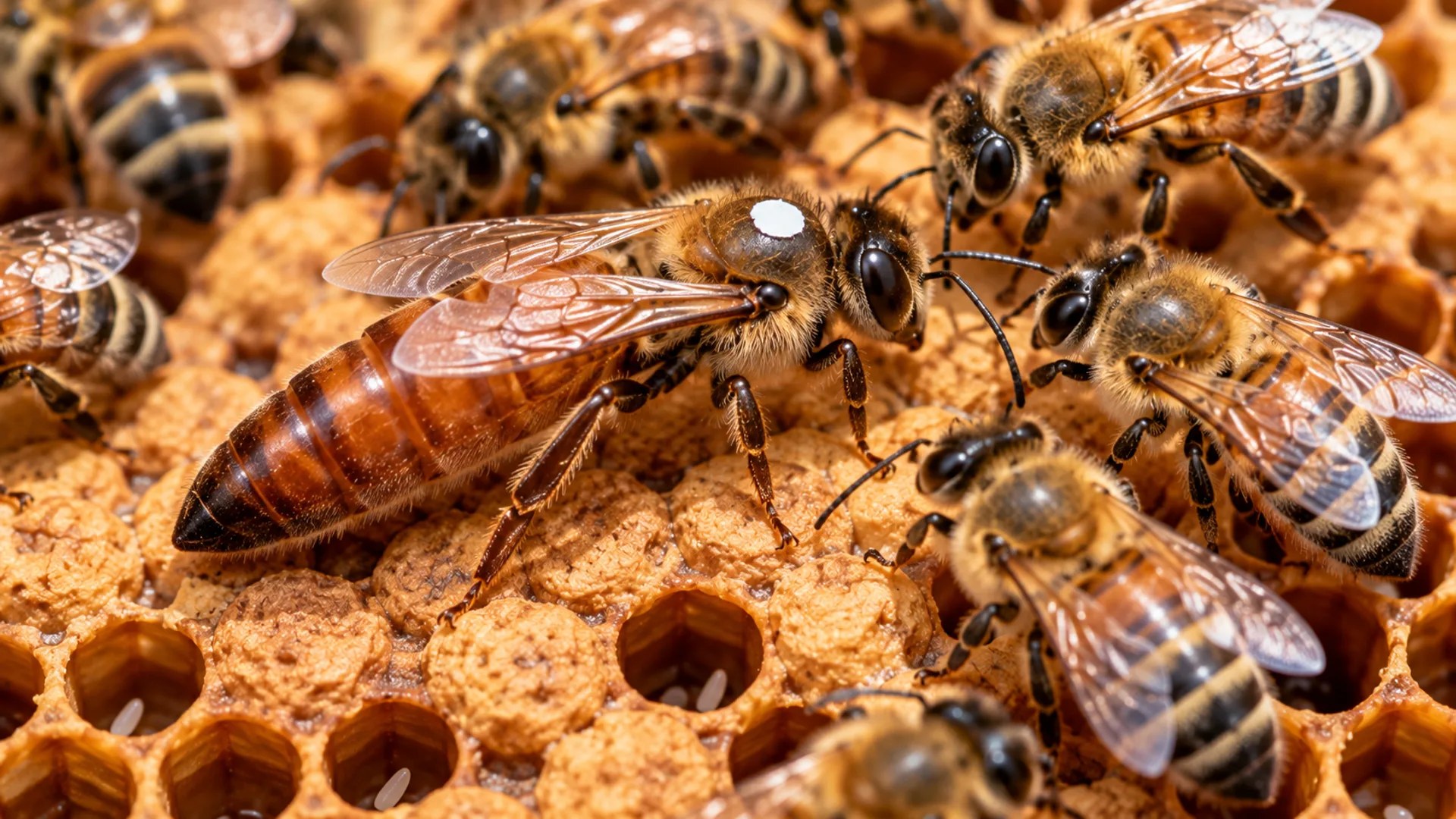
With a little practice you can pick out the queen by her shape. At about 18–22 mm she is noticeably longer than a worker (around 12–15 mm). The giveaway is her long, tapered abdomen, which extends well beyond the tips of her wings, so her wings look short for her body. Her legs are often longer and lighter in colour, and she has no pollen baskets and no wax glands.
| Feature | Queen | Worker | Drone |
|---|---|---|---|
| Number per colony | one | tens of thousands in summer | a few hundred to a few thousand, spring and summer only |
| Sex and egg | female, fertilised egg in a queen cell | female, fertilised egg in a worker cell | male, unfertilised egg |
| Egg to emergence | about 16 days | about 21 days | about 24 days |
| Body length | about 18–22 mm | about 12–15 mm | about 15–17 mm |
| Body shape | long, tapered abdomen extends beyond the wings | compact, wings cover the abdomen | bulky, huge eyes, blunt rear end |
| Sting | smooth and curved, rarely used on people | barbed | none |
| Lifespan | usually 2–3 years, up to about 5 | 5–6 weeks in summer, a few months for winter bees | a few weeks; driven out in late summer |
| Role | laying eggs, pheromones | brood care, comb building, foraging, defence | mating with queens |
Can a queen bee sting?
Yes. The queen has a sting, but it is smooth and slightly curved, without the barbs a worker has, so she can use it repeatedly without dying. Her targets are other queens: she uses it to kill rivals in their cells or in a fight. She very rarely stings people, and beekeepers who pick up a queen to mark her are almost never stung. Even so, hold her by the thorax or wings and never squeeze her abdomen.
How to spot a queen bee on the comb
Finding one queen among 30,000 bees takes practice. These habits help:
- Work calmly. Use little smoke and lift frames slowly. A disturbed queen runs to the far side of the comb or down to the edge.
- Look where the fresh eggs are. The queen usually stays in the brood nest, on frames with eggs and empty polished cells. Outer stores frames can be checked quickly.
- Watch for the retinue. Workers often form a ring around her, facing inwards, touching her with their antennae, licking and feeding her, as in the photo above. When she moves, the ring opens in front of her and closes behind.
- Watch the movement. Workers scurry; the queen walks with a steady, unhurried gait, and the other bees make way for her.
- Check the shaded side first. As soon as you lift a frame, look at the side turned away from the light. The queen avoids light and tends to move round to the shaded face.
- Mark her. A marked queen is by far the easiest to find. The paint dot on her thorax stands out at once and tells you her age from the international colour code.
If you can’t find her, don’t worry as long as you see fresh eggs: single, standing upright in the centre of the cell base. They show that a laying queen was in the colony within the last three days.
When the queen is lost or replaced
Three situations every beekeeper should recognise:
- Swarming. The old queen leaves with a large part of the colony and a young queen takes over, so the colony has no eggs for a few weeks. How to read swarm cells and use young queens to prevent swarming is covered in swarm cells found?.
- Supersedure. The colony replaces a failing queen by itself. Mother and daughter sometimes lay side by side for a short while, one of the few times two queens share a colony.
- Sudden loss. If the queen dies, the bees raise emergency queens. If that fails, the colony becomes hopelessly queenless and may develop laying workers.
Queens from the Maramureș mountains
We keep bees in Maramureș, Romania, and produce naturally mated queens there: Carnica and Buckfast from a semi-isolation mating station, plus selected Buckfast from an isolated station. Every queen is shipped marked. If you need to replace a queen or head a nucleus colony, prices and delivery windows are on our queens page.
Frequently Asked Questions
How long does a queen bee live?
In managed colonies a queen bee usually lives 2–3 years, and some reach about 5 years. Because her laying and pheromone output decline with age, many beekeepers replace queens every 1–2 years.
What does a queen bee do?
She lays the colony's eggs, often quoted at up to 1,500–2,000 a day at the peak of the season, and her pheromones (above all queen mandibular pheromone) hold the colony together, discourage queen rearing and keep the workers' ovaries inactive. The workers do everything else.
How big is a queen bee?
A queen bee is about 18–22 mm long, compared with about 12–15 mm for a worker and 15–17 mm for a drone. Her long, tapered abdomen extends well beyond her wings.
How do you spot a queen bee?
Search calmly in the brood nest on frames with fresh eggs. Look for the retinue of workers facing her, her steady, unhurried walk and her long abdomen. A queen marked with the year colour is by far the easiest to find.
How does a queen bee mate?
About 5–7 days after emerging she flies to drone congregation areas and mates in the air with roughly 10–20 drones, sometimes more, over one or a few flights. She stores the sperm in her spermatheca for life, never mates again and starts laying about 10–14 days after emerging.
How is a queen bee made?
From an ordinary fertilised egg raised in a queen cell, where the larva is fed generously on royal jelly throughout its development. The cell is capped around day 8–9 and the queen emerges around day 16 from the egg.
Can a queen bee sting?
Yes, but her sting is smooth and curved, without barbs, and she uses it mainly against rival queens. She very rarely stings people.
Related articles
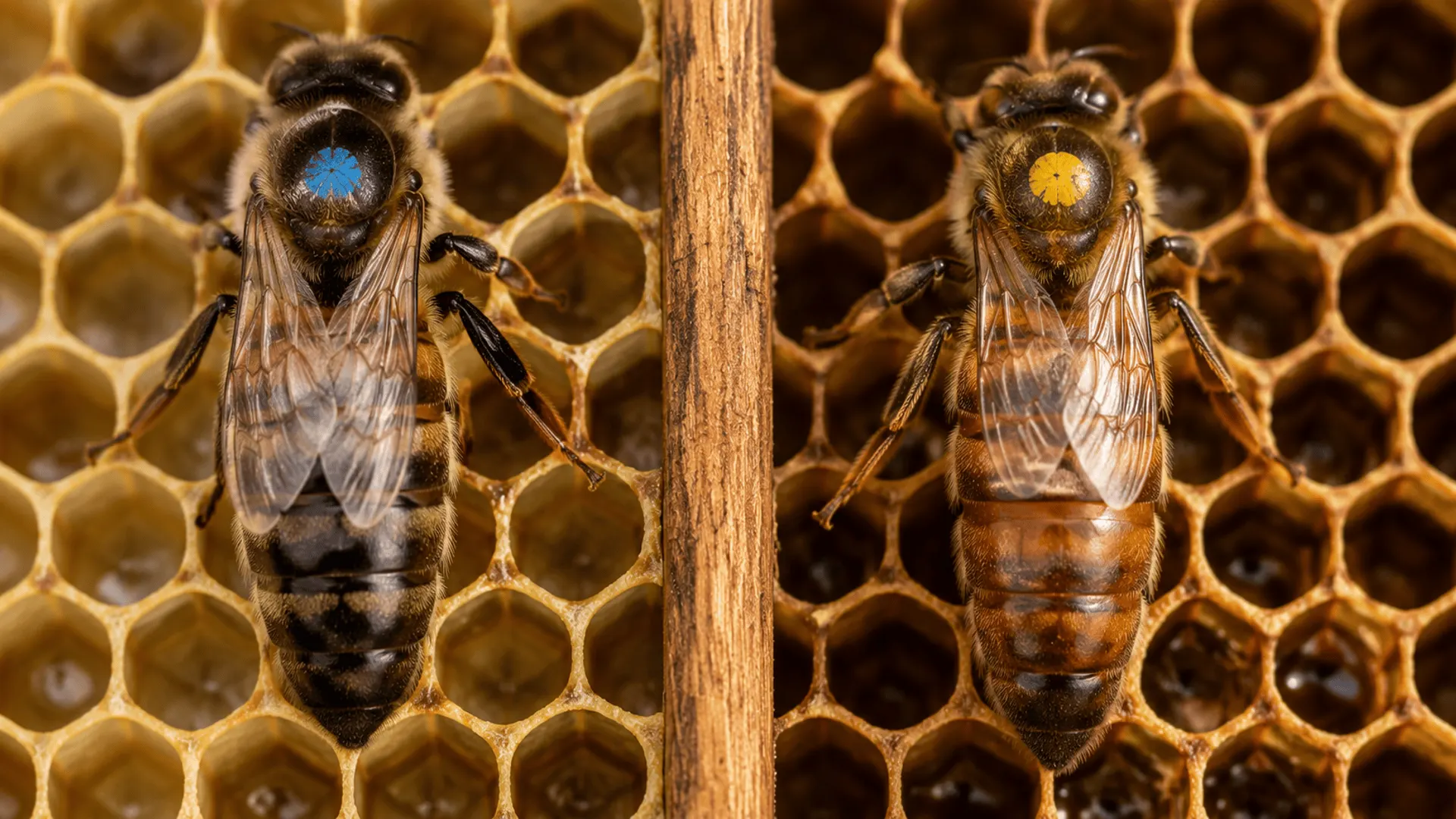
Carnica vs Buckfast: Which Queen Bee Suits Your Apiary?
Carnica vs Buckfast bees compared: temperament, honey yield, wintering, swarming and varroa. Which breed fits your climate, nectar flows and experience?
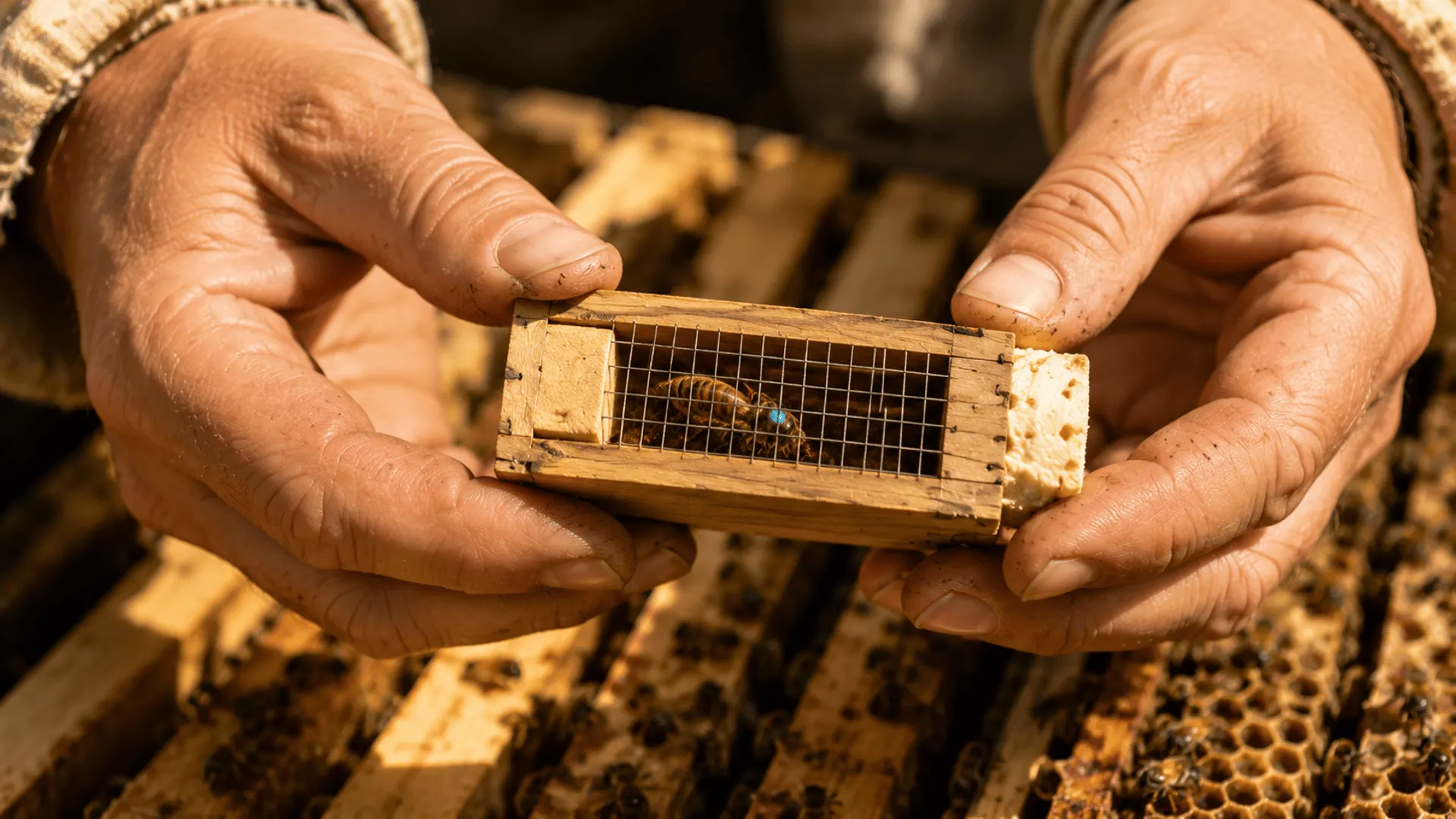
How to Introduce a Queen Bee: Step-by-Step Cage Method
How to introduce a new queen bee with the cage method: prepare the colony, place the cage, when to check, how to confirm acceptance and what to do if she fails.
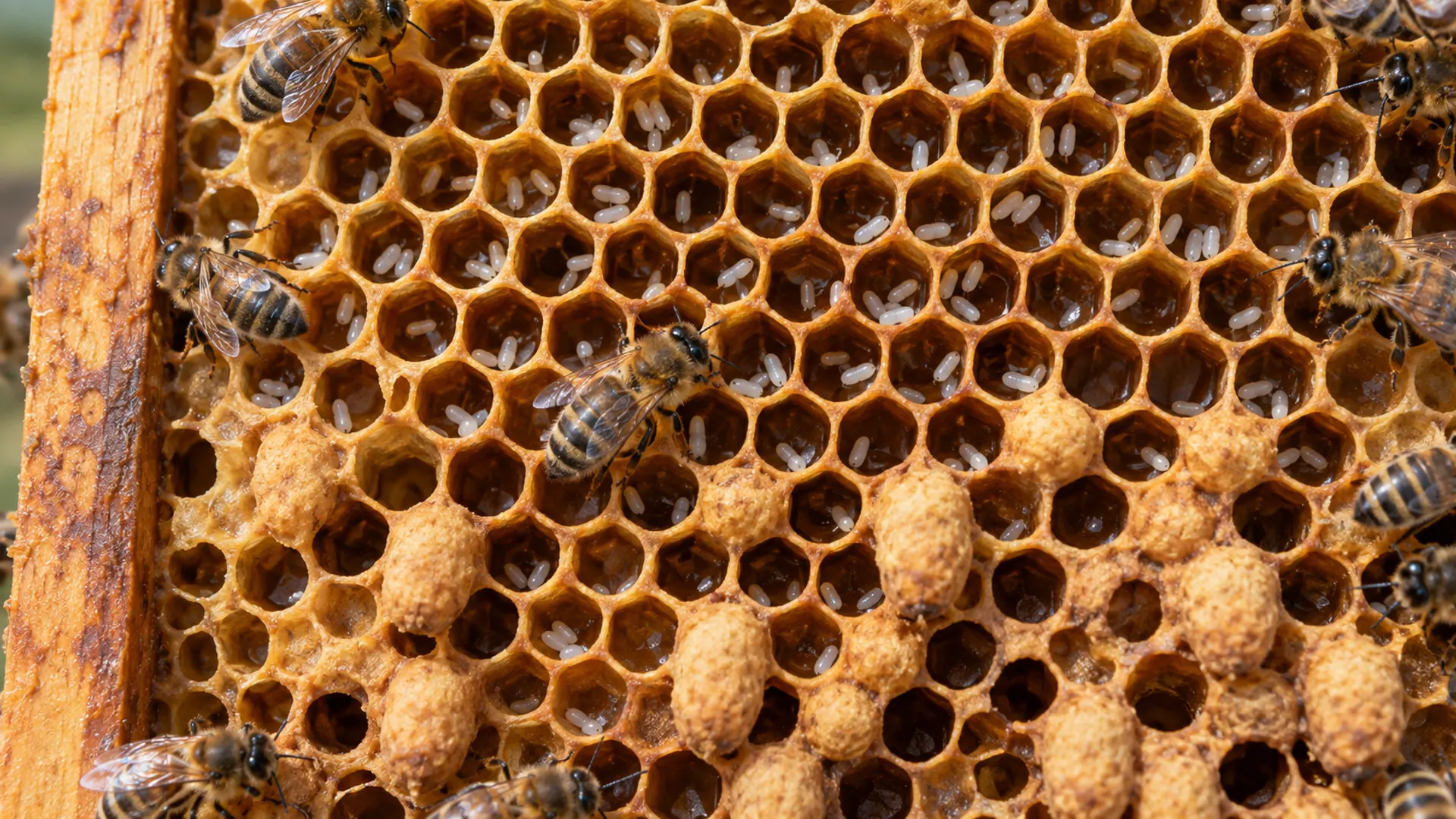
Laying Workers: How to Spot Them and Save the Colony
Laying workers or a drone-laying queen? How to tell them apart, why laying worker bees reject a new queen, and four methods that work to save the colony.